
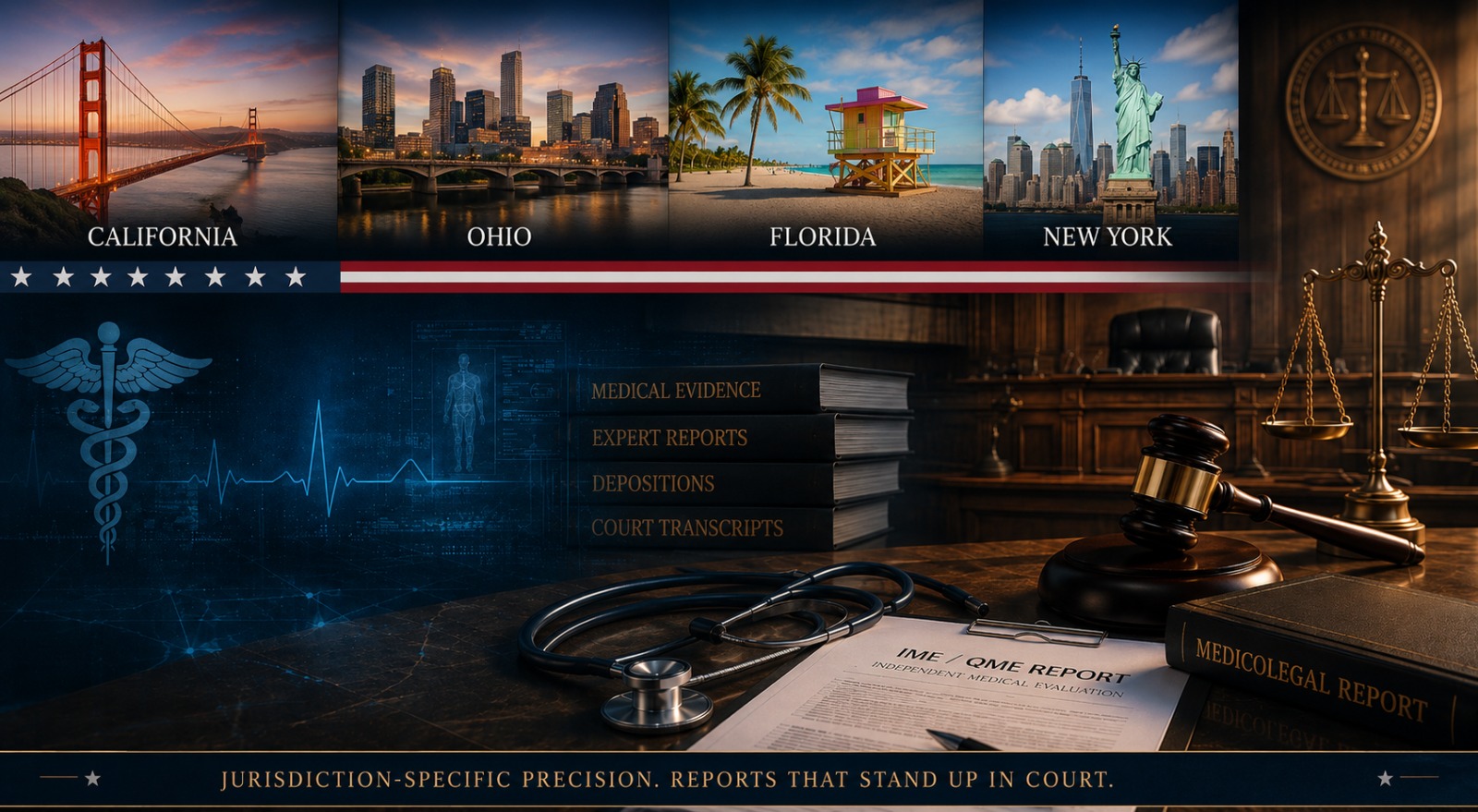
Four jurisdictions. Four different rulebooks.
QME, AME, and SIBTF don't exist everywhere. EMA doesn't exist everywhere. Every transcriptionist on your file works from a glossary built for the specific state system the report is filed under.
California
California runs on QME/AME panels, SIBTF evaluations, and a DRE-vs-ROM impairment methodology that gets challenged in litigation more than almost any other single terminology choice in the report.
- QME / PQME / AME reports
- SIBTF evaluation reports
- Permanent & Stationary (P&S) report
- PR-2 / PR-3 / PR-4 forms
- DRE Method vs. ROM Method
- Whole Person Impairment (WPI)
- AMA Guides 5th Edition
- Apportionment (Labor Code §4663/4664)
- GAF-to-WPI conversion
- AOE/COE opinion
- DSM-5-TR diagnostic criteria
- Malingering assessment
Ohio
Ohio has no QME or AME equivalent — every evaluation is an IME or DME, typically triggered by the BWC's 90-day or 200-week exam cycle, with impairment expressed as a percentage against BWC's own tables rather than AMA Guides directly.
- IME / DME (Defense Medical Exam) report
- 90-day exam report
- 200-week exam report
- Permanent partial disability (PPD) report
- Ohio BWC percentage tables
- Percentage of permanent partial disability
- Allowed condition vs. pre-existing
- Objective vs. subjective findings
- Percentage of permanent disability — psychiatric
- Allowed condition / causal relationship opinion
- DSM-5-TR diagnostic criteria
- Malingering / validity assessment
Florida
Florida's standout feature is the EMA — a state-appointed physician who breaks ties when IME and treating opinions conflict, with a legal presumption of correctness attached to the EMA's findings. Causation runs through a Major Contributing Cause standard rather than apportionment.
- IME report (Fla. Stat. §440.13)
- Expert Medical Advisor (EMA) report
- Permanent Impairment Rating (PIR) report
- Re-evaluation IME report
- Uniform Permanent Impairment Rating Schedule
- Whole Person Impairment (WPI)
- Major Contributing Cause (MCC) analysis
- Pre-existing vs. compensable injury
- MCC opinion — psychiatric
- Heightened standard for first-responder PTSD claims
- DSM-5-TR diagnostic criteria
- Malingering / validity assessment
New York
New York has no QME/AME/panel system — IME entities are directly authorized by the Workers' Compensation Board. Impairment runs through New York's own Schedule Loss of Use framework rather than AMA Guides DRE/ROM.
- IME report (WCB "I" authorization)
- Schedule Loss of Use (SLU) report
- IME-4 / IME-5 forms
- Deposition / EBT transcript
- NY Impairment Guidelines
- Schedule Loss of Use percentage
- Causal relationship analysis
- Objective vs. subjective findings
- Causally related opinion
- DSM-5-TR diagnostic criteria
- Malingering / validity assessment
- PTSD claim evaluation
State and jurisdiction questions
How state-matched transcription works across the systems we cover.
Which states do you serve?
California, Ohio, Florida, and New York, with terminology and formatting tuned to each jurisdiction's medical-legal system.
Do you know state-specific forms and terminology?
Yes. Transcriptionists are trained on the specific state system a file comes from, including PR-4 and QME language for California, EMA reports for Ohio, and IME-4/5 and SLU forms for New York.
Can you work with evaluators licensed in more than one state?
Yes. Files are routed by the jurisdiction of the evaluation, so one physician working across two states still gets state-correct reports.
Can you support a state we do not see listed?
Often, yes. Send us a sample report from that jurisdiction and we will confirm whether we can match it before you commit.